What is worth repairing
The question is not whether you can fix it. It is whether the fix will hold.
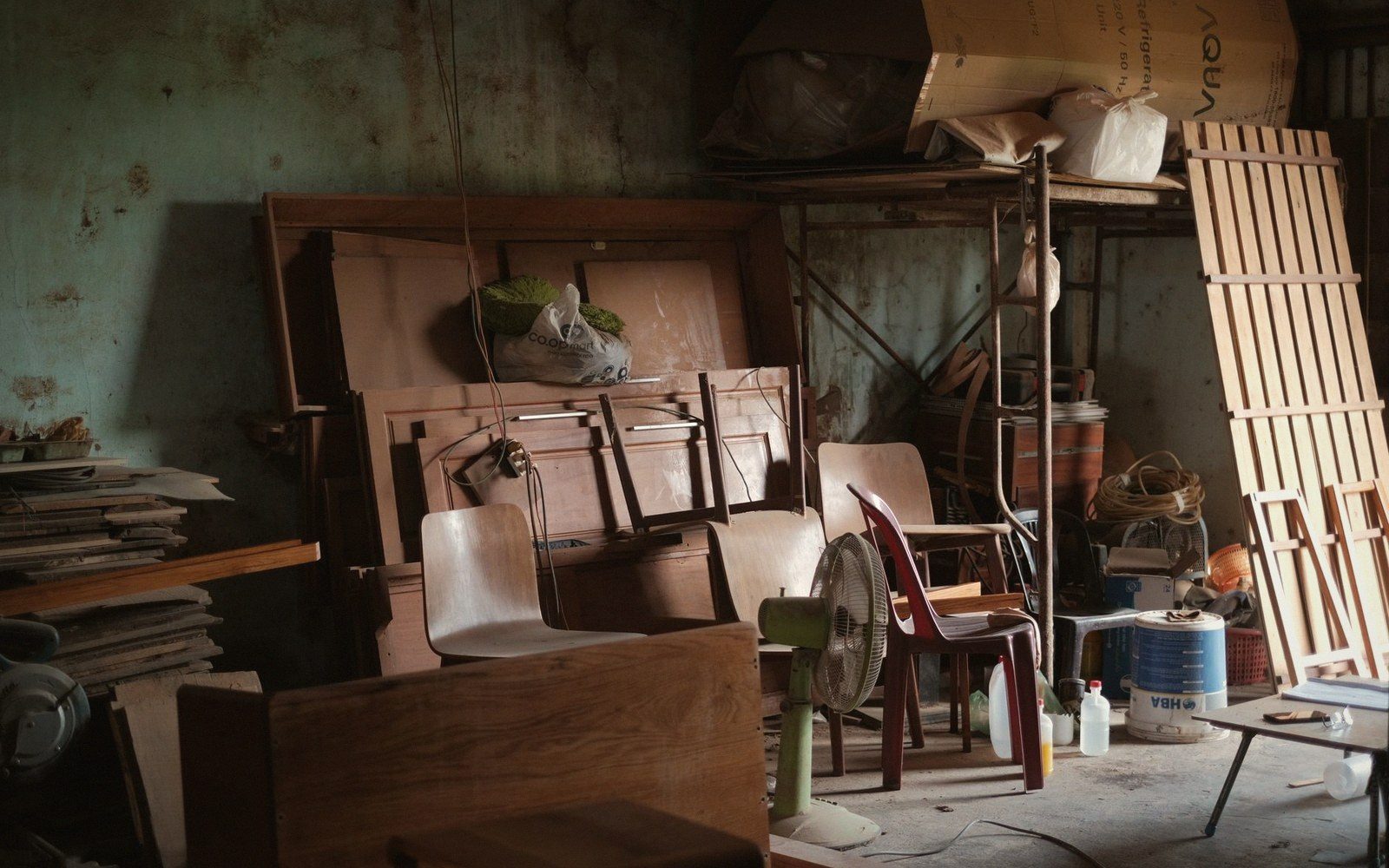
Read the construction before you commit
Pick up a chair by one leg. If it flexes at the joints, the problem is glue — a fixable problem, because the joint itself still has geometry. The tenon is still shaped to fit the mortise; the dowel still has something to grip. Clean out the old adhesive, work fresh glue into the socket, clamp it overnight, and that chair will outlast you. What you are looking at, in a well-made piece, is a structure that wants to stay together and only needs the chemistry renewed. A chair joint cleaned back to bare wood and reglued properly almost always holds.
Now pick up a flat-pack sideboard. The weight is in the carcass, not the joints, because there are no real joints — only cam locks, chipboard dowels and a back panel of hardboard held on with staples. When that begins to flex and fail, the board around the fixing has already compressed and torn. There is nothing left for a new fastener to grip, and no geometry to restore. You can spend a Saturday on it and end it with something that looks temporarily better and fails again within a month.
The rule, then, is this: solid timber and real joinery are worth an afternoon. Chipboard and staples are not.
What to look for in a piece worth saving
Run your hand along the grain. Solid timber has it running continuously; veneered board has a thin decorative layer over a substrate, and if you look at the raw edge — a drawer bottom, the underside of a shelf — you will see the layers. Veneer over MDF or ply is not necessarily a death sentence if the structure underneath is sound, but it changes what you can do. You cannot plane a veneered edge or sand through the face without hitting the substrate immediately.
Look at how things connect. Dovetails at the corners of a drawer — the interlocking wedge-shaped fingers — are not decorative; they are a mechanical joint that resists the exact forces a drawer takes in use. Mortise-and-tenon on a table leg, a bridle joint on a frame, wooden pegs in a country chair: these are joints that were made to be remade. A drawer held together with a corrugated metal fastener and glue is a different conversation.
Check for the damage you cannot undo. A broken rail with a clean break is straightforward; one that has splintered along the grain, losing material, is much harder. Veneer that has lifted cleanly can be re-adhered; veneer that has crumbled at the edges has nowhere left to bond. A surface ring-stained by a cup can be oiled or waxed back; one that has been scoured or badly scorched down through the finish and into the wood itself will need more thought. Scratches are usually surface. Swelling from water is almost always not.
There is nothing left for a new fastener to grip, and no geometry to restore.
Upholstered pieces add a layer. The frame is what matters: press on the seat and feel whether it shifts. If the corner blocks are intact and the frame is rigid, the fabric and the filling above them are simply material — replaceable and not especially expensive in time. If the frame rocks, you are looking at a structural repair before you get anywhere near the fabric.
The question you are actually asking
When a piece is made of real materials and real methods, repair returns it to what it was. When it is made of compressed wood fibre and mechanical fixings designed to be assembled once, repair is improvisation against a structure that was not built to be taken apart and put back together. The second-hand market is full of both. The difference is usually visible in thirty seconds if you know to look.
Spend your Saturday on the thing that was made to last.